Showing posts with label sundew. Show all posts

Sunday, 25 May 2014

Photo's galore!

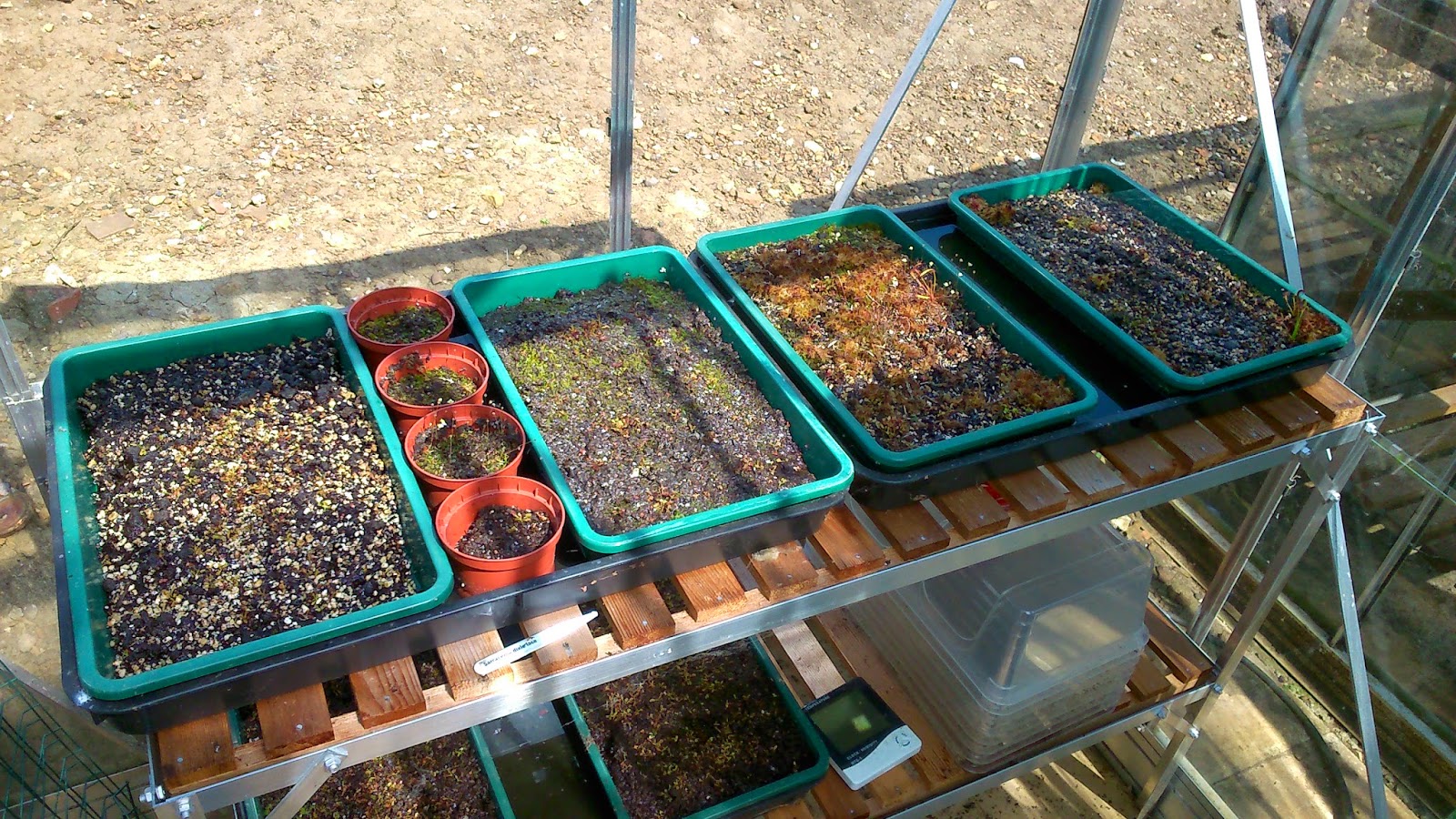
It's been a while since I've added a bunch of photos to this blog, so here's my collection of photos from both greenhouses as of May 2014:


The first plant I have grown from seed

Add caption


Seed's for VFT 'Shark Tooth' form

Flower from a Cobra Lily


The 'B52' crew :D


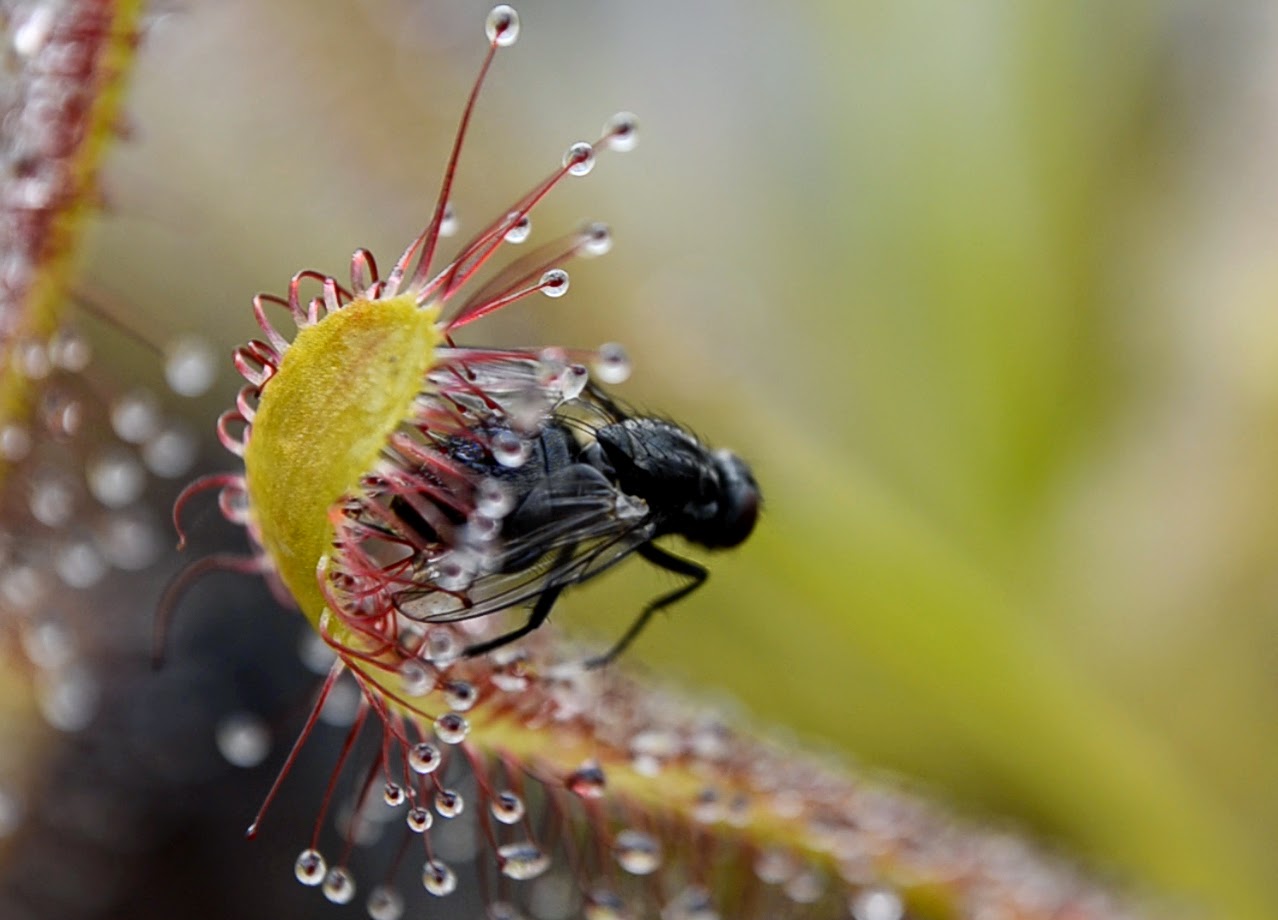
Nice to see one of my Sundews catch a good sized fly


Spot the spider!


A picture of a Sundew that ISN'T a macro? I must be mad!


Thursday, 8 May 2014

We're going liiiiiiiive!

Today is a glorious day.

Ok, its not actually cause it is raining outside, but it is good because very soon, this weekend infact, my business will start up. This is good, because it's been something I've been preparing for for over a year.

After spending so long as a child looking everywhere for even one carnivorous plant, I now find myself in a position whereby I have a couple of hundred to sell. I am starting off locally first. People who live in the area. Friends. Friends of friends etc. Then all being well, I hope to go nationally so I can supply people from all over the country. 'tis all about spreading the happiness and intrigue!

If you want to check out my site, go to www.carnivorous-corner.co.uk. This will provide more information about the plant's I am selling, as well as nice photos (if I do say so myself!), videos of the plants, frequently asked questions, and an introduction to how they all work.

If you want to read my ramblings in 140 characters or less, go to @plantsthateat on twitter. In the meantime, here's a nice macro of  a Sundew:


Thursday, 6 March 2014

Wacky Weather

We are now in March, and this winter, we've had probably the least amount of snow I've ever known for a winter. How cool is that? Well, not very apparently, as during one or two of the latter days of February, my automatic vents on my greenhouse opened up, due to the greenhouse getting to near 20'c inside! In February!

My Drosera Regia's are also still alive. Not something I was expecting as they come from South Africa. Infact, fingers crossed of course, most of my plant's seem to have made it through the winter, with the exception of one or two sundews.

My website is well under way now. I had considered getting rid of this blog and using the new website's blog to update things, but the truth is, I really like the layout of this current blog, so I will be doing a link to it from my website instead.

This reminds me, soon I have to order some new labels for plants, and of course a table and couple of chairs for when I go to the gala's and car boot sales to sell these plants in person. Roll on May!

Tuesday, 4 February 2014

Now. We. Wait.

I've had a number of people ask me over the last few weeks when I will be ready to  sell my plants. The answer is about April / May time because at the moment, they are all in dormancy (as the photos below show).

Repotting is now complete for this year, and I am totalling around 540 plants. I have also tried out some experimenting this year. A few of my Sarracenia's (Pitcher Plants) are nearly 2 ft tall but are in pots so small that the root's are sticking out of the holes in the bottom. Not only have I put them into a larger pot, but the pot's I have put them into are several times the size. I am hoping this encourages them to grow even taller and maybe even max out their height (1.2 metres) within a couple of years.

Also worth noting that I won't be selling my plants internationally. They will be strictly UK only. Plants are not allowed to be posted to the EU, and the expensive posting price to the US simply isn't worth it. Besides, you US/Canadian lot have a greater variety of plants with easier access over there :)


Sunday, 26 January 2014

Ready.....set........repot!

Although February is the most 'ideal' time to repot, or at least the most common time among carnivorous plant collectors to do it, I tend to lack patience. A week or two early won't make a difference anyway!

So far, I have repotted all of my Venus Flytraps, most of my Sundews, and started on my Pitcher Plants. For the flytraps, I was using a slightly different compost mix to usual. I bought it from a different site and its one that I have used for my flytrap seeds, and they seem to be doing really good. I think I will end up preferring this new compost as it is already quite damp, so unlike the previous compost, I don't need to be standing there watering it for 11 hours just to get it a bit damp.

I have had a few deaths, admittedly. Most, if not all of which, were sundews. Typically the tropical ones which don't tend to like temperatures dropping below about 8'c, which doesn't help when some days it is just above freezing. Still though, a handful of sundew deaths while over 40 still remain is a pretty decent ratio.

Speaking of ratio's, once again my venus flytraps surprise me. Times when I thought I could divide a plant 2 or 3 times and end up splitting the contents of a single pot into 8 pots is always great. Assuming they all survive this winter, I will be rockin' over 300 flytraps alone.

I've had less success with the divisions of the pitcher plants though. Admittedly, you are supposed to divide them every couple of years rather than every year, which would explain why I have taken half a dozen out of their pots, only to realise they are one whole plant and don't want to be divided yet.

I'm also doing a bit of experimenting this year with plant sizes. Pitcher Plants are said to be able to grow to just over 1 metre in height. My tallest ones last year were about 2ft in height, so to help encourage them to grow further, I have ordered and received a few extra large plant pots, which are 5cm wider and 5cm deeper than my current largest ones. This is obviously to encourage the roots to dig deeper and give them more space. Hopefully at least one of my plants can reach the 1 metre mark in the next couple of years!

It's also worth noting that I have made several divisions of the Cobra Lily's. There is certainly a fascination about them among people who see my plants. Truth is, they are still relatively 'new' to me in terms of understanding how they work and what conditions they like compared to other carnivorous plants. Still, I have 7 or 8 pots of them now and this is the first proper divide that I have put them through, and their root systems seem slightly different to that of my other plants, so we will see how well they do.


Saturday, 28 December 2013

It's the dormant time of the year again...

I hate this time of the year. Yes its cold, often damp, probably soon to be snowy and icy and the days are far too short. To top that off though, carnivorous plants go dormant until about March/April time and currently look.........a bit crap really. In Spring, they will once again form new traps and stand colourful and tall and ready to help diminish the insect population.

Until then though, I am continuing to work on the new website. And by "work", I mean of course telling the designer what I am after! All being well, it will be up and running by next spring and I can start selling some plants. Not just via the website though, but also, perhaps even more importantly, through car boot sales. I enjoyed being at the Caythorpe Gala this year (or last year if your reading this in January!). It was a good opportunity to talk to people about these plants and also to put my finger on the pulse of what people were after and interested in. One of the best examples being that although venus flytraps are the most well known plant, it was the Pitcher Plant's that generated probably the most interest for people.

I also found out this year that Venus flytraps, or any plants for that matter, can't be posted internationally to Europe. I put a group of 6 flytraps on ebay, setting the, erm, settings to make sure only people from the UK could buy them. Somehow, the winning bidder was from Latvia. I didn't really bother questioning how it happened in spite of my specific settings, but instead set out to post it to his/her country, curious as to how much it would cost me in postage.

I took the parcel to the post office, and the lady said "do you mind me asking what is in the box?". I told her "oh, nothing too expensive, just a few venus flytraps". "Oh", she said. "You can't post them to Europe". Low and behold, she gave me a leaflet containing the 7000 item categories you're not allowed to post abroad, and the 3 items you are. I apologised to the ebayer and refunded him/her. Was feeling slightly crushed that being an international seller of these plants went out of the window though. Still, this mean's that I will be completely focused on the national sales for these plants and frankly, I can't wait!


Sunday, 1 September 2013

Sundew Care Guide


Sundew Care Guide

Light
Sundews are the ideal windowsill plant. Putting them in a place that receives a lot of sun is fine, but in the wild, sundews grow among grass and larger plants, so they don’t mind being in the shade for part of the day, as long as they get a couple of hours of sunlight. They can be grown outdoors, provided the climate is warm enough, but it’s usually best to bring them indoors during winter.

Water                            
Do NOT use tap water, use  rainwater
Tap water contains chemicals which will harm the plant. You can use distilled water, reverse osmosis water, but the best water to use is rain water. Stand the pot in 1 - 2 cm of rain water, but during the winter months, its best to just keep them damp (such as using a mist spray) rather than fill the tray up with water.

Feeding
The leaves of a sundew are littered with tentacles which have what looks like a dew type substance on the end of them. Insects are attracted to them by the sweet mucilage and when they land on one of these tentacles, they get stuck! 

The tentacles near to the prey all lean towards the prey to prevent it from escaping and bring it towards the leaf of the plant for it to get digested. In the case of some plants, such as the Drosera Capensis, this can all happen within a few minutes. In the case of a Capensis, the leaf itself will sometimes actually curl over the insect to make sure it’s well and truly trapped.

Sundews most commonly eat small insects such as gnats and small houseflies. If you see a small fly going around the house, when it lands, you can use the sundew to catch it (feeding time!). Just be sure not to overwhelm the leaf with too many insects. Depending on their size, only a few insects are more than enough per leaf. Though like the flytrap, they are good at catching insects on their own.  

Winter dormancy
Winter dormancy for a sundew typically takes place from late October to February. During dormancy, the plants leaves will lose their stickiness and die back and so it is important to prune them. If your sundew is outside, bring it inside, preferably somewhere where it still gets daylight but feels cooler (such as a conservatory).

Sunday, 16 June 2013

Top tip: Use Sundews to catch flies

It can often be awkward trying to catch flies with your fingers or even trying to zap them with one of those tennis racket shaped zappers, but sundews work a treat.

The great thing about them is, not just that they are sticky so they stop even the largest of flies briefly enough for you to grab hold of them, but also because flies dont seem to be afraid of sundews. Try to catch a fly with your finger and they will usually fly off before you get chance to grab them. But with using a sundew, the flies either dont fly away and get stuck to the plant, or in some cases, they even fly into it.